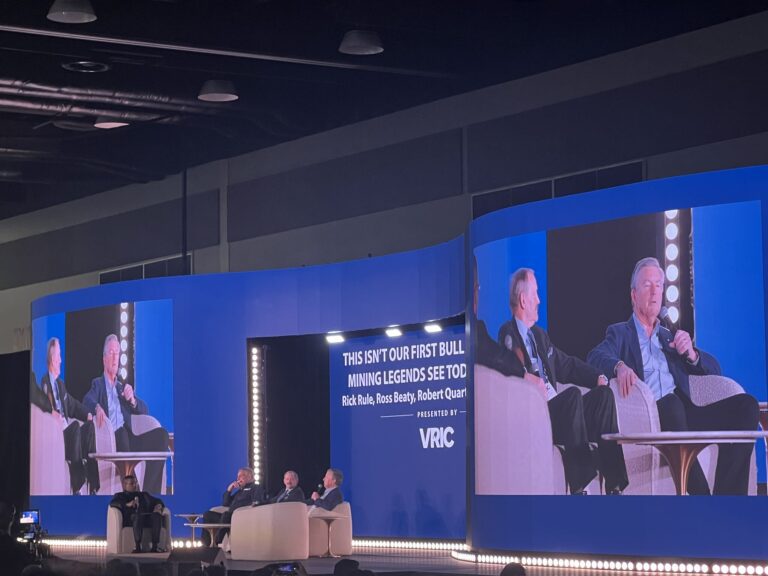

At this year’s Minexchange in Salt Lake City, Managing Director Michael MacMillan had the opportunity to speak at the Mining Exploration Risk session about a topic that is rapidly reshaping how mining companies earn and lose trust: artificial intelligence.
The core message is simple but urgent: your reputation is no longer shaped only by people. It is increasingly shaped by machines. And understand ing how those machines are fed is critical.
Welcome to the Era of Reputation Engineering
For decades, mining reputation has been built through tried and true methods: community meetings, investor presentations, media coverage, sustainability reports, and word of mouth. That ecosystem still matters. But today, AI systems are increasingly acting as the first interpreter of your company’s story.
Search engines now deliver AI-generated summaries. Investor platforms use automated scoring. Chatbots synthesize narratives about your environmental and social performance. In many cases, stakeholders are seeing an AI-generated interpretation of your company before they ever read your website.
And all this is changing what we know about public communications.
If your information is inconsistent or outdated, AI will fill the gaps using whatever sources it can find. In practical terms, that means your reputation can be defined algorithmically without your participation. This is why companies need to embrace reputation engineering: a structured, proactive approach to building trust in an AI-mediated information environment.
The Mining Trust Gap Is Now a Machine-Scale Problem
Mining has long faced a trust gap. Historically, some leaders responded with caution, believing that:
- Silence is safer than engagement, or;
- Output (more reports, more releases) equals impact.
But the data tells a different story. When companies remain silent, stakeholders often assume the worst. And in an AI-driven search environment, silence does not create neutrality it creates absence. And absence invites substitution.
Increasingly, the rise of “zero-click search” – a term that describes the shift to AI summaries in search means users receive a synthesized answer rather than a list of links. That summary effectively becomes “the truth” in the moment. If your organization has not structured clear, credible, machine-readable information, you are not competing in that environment.
Communications as Infrastructure
One of the key themes in Salt Lake City was shifting from viewing communications as output to viewing it as infrastructure.
Reputation engineering is not spin. It is about building a durable, structured information layer that both humans and machines can trust.
That means:
- Clear, consistent descriptions of operations and commitments
- Data formatted in ways AI systems can parse
- Repeated key messages across platforms
- Regular factual updates that signal recency
- Third-party validation where possible
Using AI to Strengthen Trust
The opportunity is just as significant as the risk. Mining companies can apply AI directly to their communications workflows.
- Monitoring stakeholder sentiment in real time
- Converting financial results into clearer investor narratives
- Transforming ESG data into visual, community-ready stories
- Identifying perception gaps between official messaging and AI-generated summaries
In one example we shared, chatbot testing revealed that a company’s core business strengths were resonating — but its strongest trust-building efforts in ESG and community impact were underrepresented in AI responses. That insight allowed for targeted, practical adjustments.
The Time to Act is Now
The next 12 to 18 months represent a critical transition period. AI search behaviors are accelerating. AI-generated content is multiplying. Information density is increasing — and credibility is becoming a premium asset.
Mining companies that act now can establish strong, machine-readable foundations that shape how they are interpreted for years to come.
Those that wait may find their reputations engineered by default.